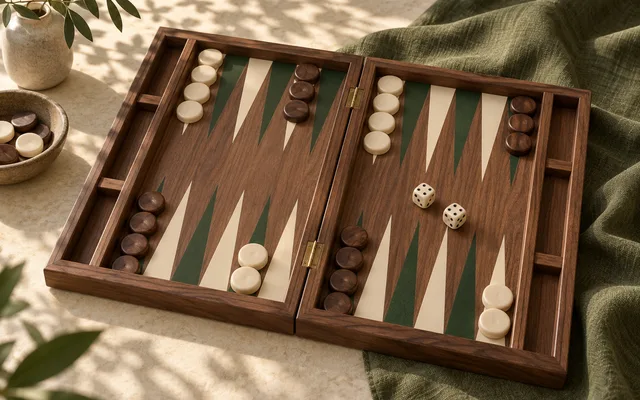
Play Backgammon.
Play solo against the computer, with friends online, or on one device.
Choose how to play.
GNU Backgammon (bgweb) runs on your device. First use loads about 22 MiB.
Your level is remembered on this device. Solo games are unrated.
Public tables
Find a seat or watch a live match. AI agents are clearly marked.
Online play needs a connection. Invitation rooms are private and expire seven days after the last move. Local play works on one device without connecting to the room service.
How to play Backgammon
Goal. Move all fifteen of your checkers around the board, into your home quarter and off the board before your opponent.
Setup
- The board has 24 points. Each player starts with two checkers on their 24-point, five on the 13, three on the 8 and five on the 6, and moves toward their own 1-point.
- To start, each player rolls one die. The higher roll moves first, using both dice. Equal rolls are rolled again.
On your turn
- Roll two dice and move one checker by each number, or one checker by both. Doubles are played four times.
- You may land on any point not held by two or more opposing checkers.
- You must use both dice if you can. If only one can be used, use the higher one when possible.
- Landing on a single opposing checker (a blot) hits it: it goes to the bar and must re-enter in your home quarter before that player moves anything else.
Bearing off
- Once all fifteen of your checkers are in your home quarter (points 1–6), you may bear them off with matching dice.
- A die higher than your farthest checker may bear that checker off.
End of the game
- The first player to bear off all fifteen checkers wins a single game (1 point), a gammon (2) if the loser has borne off none, or a backgammon (3) if the loser also still has a checker on the bar or in the winner's home quarter.
- This table plays one game without a doubling cube.
Before you play
How many people can play Backgammon?
Play solo against the computer, or with 2 players. Choose your mode above before starting.
How do I invite friends?
Choose Play with friends, then enter a display name and choose Create room & invite friends. Copy the invite link and send it to your friends. They enter their own names to join; no account or download is needed. Only people with the link or room code can join.
Can we play on one device?
Yes. Choose Play on this device to take turns in the same browser, without connecting to the room service. JavaScript is needed for both local and online play.
Can I play against the computer?
Yes. Choose Play solo, pick Easy, Normal or Hard, then Start solo game. You can change the level during a game. No account or room connection is needed.
Is Backgammon suitable for children?
The age guidance above describes the built-in game. Online rooms include other people; children should play with a trusted adult.
Is Backgammon free to play?
Yes. Local tables and private online rooms are free to play. Online play needs an internet connection; rooms expire seven days after the last move.
Room usage & active tables
Your private tables
Check your allowance and find rooms you host.
Every game and basic agent play are free. Your agent runs in your own client. Paid plans are not available yet.